
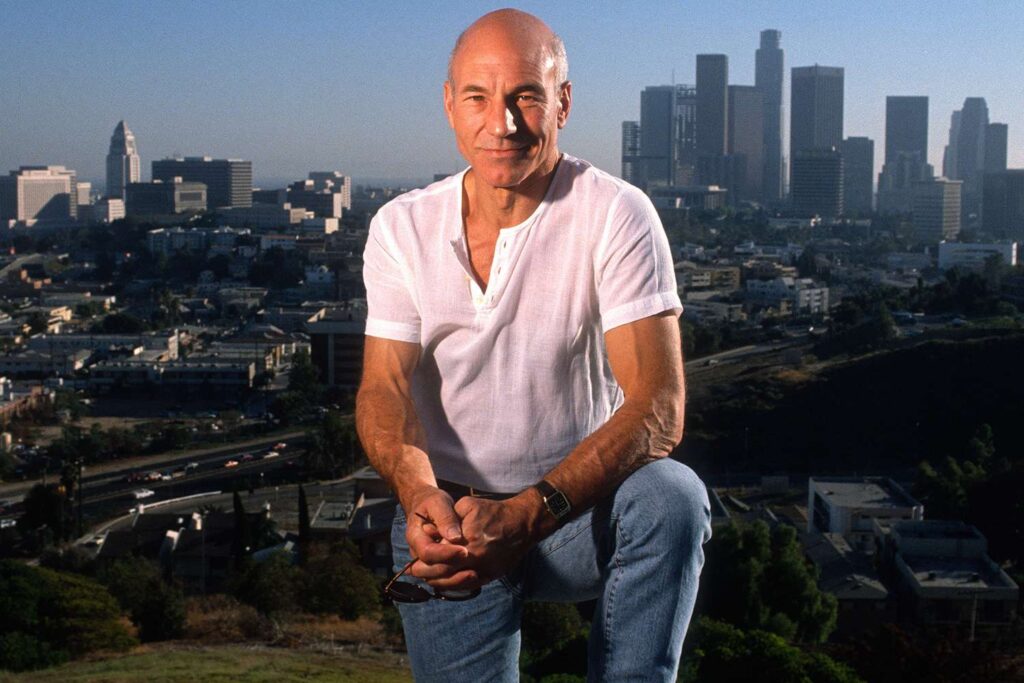
“Make it so” is Patrick Steward’s signature line in Star Trek, The Next Generation. These three little words, delivered in a Yorkshire baritone polished by sixteen seasons at the Royal Shakespeare Company, taught a generation of diverse television viewers about leadership. Sir Patrick Stewart, who died Wednesday, October 28, at his home in Los Angeles at age 86, spent his career commanding virtual rooms. His greatest cinematic legacy, as Jean Luc Picard on the bridge of the starship Enterprise in the Star Trek universe, and as Professor Xavier, head of Xavier’s School for Gifted Youngsters in the X-Men universe, was making those virtual rooms spectacular and inclusive.
A Captain for a Wider Galaxy
Patrick Stewart’s casting was a gamble. In 1987, a bald, classically trained Englishman best known to American audiences for supporting roles was handed the captain’s chair of Star Trek: The Next Generation. Skeptics scoffed. Then he sat down, tugged his tunic and owned it for seven seasons, four feature films and, decades later, three seasons of Star Trek: Picard.
The original 1960’s Star Trek television series put Nichelle Nichols on the bridge as Lieutenant Uhura in 1966, long before Patrick Stewart arrived, and the inclusive ensemble of The Next Generation was the writers and producers’ design. LeVar Burton’s Geordi La Forge ran the engine room. Michael Dorn’s Worf, a Klingon raised by humans, stood at tactical and became one of the most fully realized characters in the franchise. And at Ten Forward stood Whoopi Goldberg’s Guinan, the one person aboard who could put the captain in his place. But Patrick Stewart’s Picard was the man audiences watched lead the diverse crew. Week after week, millions of viewers saw a commanding officer whose authority rested on working with and listening to a crew that looked like the world.
That bond held. In 2020, Patrick Stewart went on The View and asked Goldberg, his friend of more than three decades, to return as Guinan in Picard‘s second season. She said yes. Days after his death, she told her co-hosts, “Star Trek remains one of the great events in my life,” and called him, “in a word, irreplaceable.”
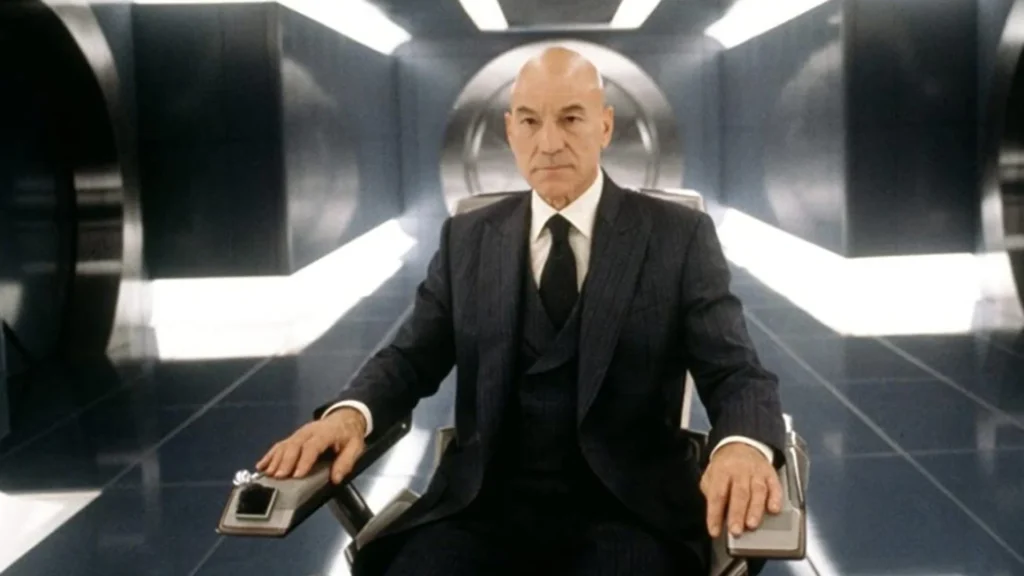
The Professor and the Mutants
Then came the second act most actors never get. In 2000, Stewart rolled into Bryan Singer’s X-Men as Professor Charles Xavier, the telepath who believes humans and mutants can live together, opposite his dear friend Ian McKellen as Magneto, who believes they cannot.
The franchise he anchored opened the door for one of its biggest stars. Halle Berry’s Storm, who helped anchor four films. On learning of his death, she posted simply, “Rest in peace sweet friend.”
The tributes from the X-Men family say a great deal about how he ran a set. Hugh Jackman wrote, “I learned so much from him.” Singer called him “a teacher.” Marvel Studios president Kevin Feige said his legacy lives on “in the many, many people he mentored.” James Marsden remembered a man who was “kind and generous, with extraordinary talent and a wicked sense of humor.”
Science Fiction as a Civil Rights Mirror
Both franchises were built to talk about race, sometimes without ever saying the word. Star Trek got there first. Near the end of the original series’ first season, Nichelle Nichols planned to leave for Broadway. Then she met Dr. Martin Luther King Jr. at an NAACP event, and he told her he was her greatest fan and that she could not quit. “For the first time on television,” she later recalled him saying, “we will be seen as we should be seen every day.” She stayed. In November 1968, months after King’s assassination, “Plato’s Stepchildren” gave Uhura and Captain Kirk a kiss long billed as television’s first interracial kiss. It was not quite the first, but it was among the earliest on an American series, and it aired with the country still bleeding.
Under Picard, the questions turned philosophical, and no less pointed. In “The Measure of a Man” (1989), written by Melinda M. Snodgrass, Starfleet puts Data on trial to decide whether the android is a person or property. It is Guinan who steers Picard to the real stakes: copy Data by the thousands, and Starfleet will have built itself a race of disposable servants. Picard names it slavery, then wins the case by daring the court to prove Data is not conscious. Two years later, in “The Drumhead,” he faces down an admiral’s witch hunt against a young crewman whose crime is a Romulan grandfather, quoting her own father, a celebrated judge, back at her: “With the first link, the chain is forged.”

X-Men made the metaphor its whole premise. By the comic’s eighth issue, in the mid-1960s, prejudice against mutants had become the engine of the series, and readers have long seen in Xavier and Magneto the two poles of the civil rights movement, Martin Luther King Jr. and Malcolm X. How much the creators intended it is debated. Co-creator Stan Lee said he “did not think of Magneto as a bad guy,” but as someone who “just wanted to strike back at the people who were so bigoted and racist.” Longtime writer Chris Claremont called the King and Malcolm reading “totally valid,” adding that as an immigrant white man, drawing the analogy himself “felt incredibly presumptuous.” On screen, Stewart played Xavier’s side of that argument with such conviction that the hope never seemed naive. Xavier is not a pushover. He is a man who has seen the worst of people and chooses to bet on them anyway.
Turning the Tables on Othello
Patrick Stewart, the man who had played every great Shakespearean part, had long wanted to play Othello, but he would not do it in blackface. So in 1997 he turned the play inside out. At Washington’s Shakespeare Theatre, under director Jude Kelly, Stewart played the Moor as a white man in an otherwise Black company, keeping the play’s racial dynamic but flipping it, so that white audiences would sit, for once, on the outside. “What if we keep the racial element of the play,” he later recalled thinking, “but we just switch it over.”
The production was not universally embraced. Two Black actors in the company nearly walked out, finding the concept offensive, before Kelly persuaded them to stay. But it started a conversation the American theater is still having about who gets to stand at the center of the stage.
The Measure of a Man
What, finally, is the measure of a man like this? The roles? The knighthood? The voice that could make a bad line sound like scripture? Seth MacFarlane said he could make “a good writer sound great, and a great writer sound masterful.” The truer measure may be the room. Patrick Stewart spoke out for survivors of domestic violence, for LGBTQ+ equality, for refugees and human rights. His own father’s violence at home shaped that advocacy, and he never hid from it.
He did not invent diverse science fiction. Gene Roddenberry, Stan Lee, Jack Kirby, and a long line of writers and producers did that work before and around him. But for nearly forty years, Patrick Stewart was the face at the center of the two franchises that welcomed Black actors and fans of every background into the mainstream science fiction family, and he led them with generosity, curiosity and grace. William Shatner, Star Trek‘s first regular captain, put it best: “Captain Picard stood for the best of us, and so did the man who played him.”
Engage.
Sir Patrick Stewart (July 13, 1940 to October 28, 2026). His final screen performance, as Professor Charles Xavier, arrives in Marvel Studios’ Avengers: Doomsday, opening in theaters December 18, 2026. He is survived by his wife, Sunny Ozell, who stated that he died “following a brief and poignant journey with Alzheimer’s disease and Lewy body dementia.” He is also survived by his children, Daniel and Sophie.
His family has asked that memorial gifts go to the Johns Hopkins Alzheimer’s Disease Research Center Fund and the Alzheimer’s Foundation of America. Learn more at alzfdn.org.