
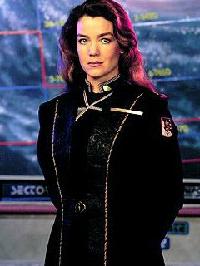
Actress Claudia Christian, a veteran guest speaker on the sci-fi convention circuit, made a similar observation. “It seems there has always been women in [sci-fi], in the audience, and on the screen.”[iv] Whatever the reason for the change in the number of reported female fans, one apparent corollary is the rise of the strong female lead archetype now pervasive in science fiction television.
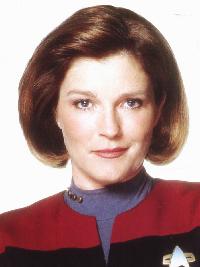
As played by Kate Mulgrew, Janeway was gentle yet capable. In sharp contrast, Babylon 5’s Susan Ivanova was sardonic, yet highly effective. Taking the helm of Voyager some two years after Ivanova first walked the halls of Babylon 5, Janeway’s matronly persona may have been a direct answer to Ivanova’s stark cynicism. And while the two characterizations were entertaining, they were both extremes that left audiences wanting more nuanced character development.
Newer shows such as Andromeda and Battlestar Galactica answered the call for more nuanced character development by equipping their leading ladies with smarts, strength, and sex appeal. Battlestar Galactica boldly went one step further by also giving sci-fi gals strong libidos. How are some of the brightest female stars in sci-fi television affected by this trend? Popdecay spoke with several of television’s leading actresses at the Ladies of Sci-Fi convention in Orlando, Florida, for their thoughts.
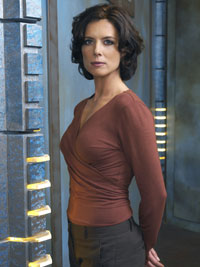
Torri Higginson, surprisingly fiery yet known for her role as the dreary Dr. Elizabeth Weir on Stargate: Atlantis, explained that the “beauty of science fiction is that you get to play drastically different roles within your character.”[v] But writers had given Weir just one romantic encounter in three years. “Where are the alien boys?”[vi] Higginson laughed.
While not an android, Higginson’s Weir is virtually written as one, since she lives an ascetic lifestyle while her male counterparts regularly play the field. “I’d love to play a bad girl; it is more interesting, and it is more fun.”[vii] When asked whether she is concerned with typecasting, Higginson said no, but then vigorously added that there is an ongoing need for more women directors, producers, and writers of every color. While Janeway’s “asexual human” sub-archetype endures for some actresses, as is evidenced by Weir’s character, others face a different situation.
Brandy Ledford, who played the sensual android Doyle in Andromeda, often portrays the vamp in sci-fi television. When asked what role she would like to play, Ledford offered, “ I would love to play Laura Croft, who is simultaneously beautiful, strong, smart, and talented.”[viii] She added that there just are not that many good roles out there written for such a strong character.
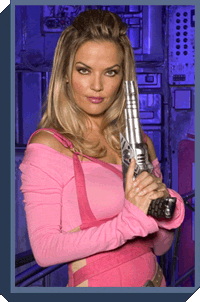
Ledford, who is as serious and sharp as she plays vampy on TV, believes there may have been some typecasting in her case. And yet she embraces possible typecasting as part of the actor’s experience. In looking back, Ledford said, Doyle “really was the token eye-candy bimbo [despite appearances].”[ix]
Some fans view Battlestar Galactica’s Starbuck as a compromise between the dichotomies of the asexual human and the vampy driod. Portrayed by Saturn Award winner Katee Sackhoff, Starbuck may be the first Gen X-Y-Z-er in space.
Hardly an asexual human, Starbuck is imbued with android-like strength, acumen, and a sexual appetite that might rival James T. Kirk’s were Cylon men hewn from prettier stuff. Overall, Starbuck falls somewhere between Ivanova’s blunt humanity and the sexy robot. While she fights, drinks, and shags like a minx, she retains the sex appeal often reserved for the vampy android.
Still, fans have not seen a truly emotionally open Starbuck. When Leoben convinced her that Kacey was her daughter, Starbuck appeared to recover rather quickly after learning Kacey was not hers. To the show’s credit, Battlestar Galactica seems to have a female character for every personality type in the spectrum. And, judging from the fan reaction to Katee Sackhoff during the Ladies of Sci Fi Convention, that coverage has made for wonderfully entertaining television. Yet Starbuck’s characterization suggests that while science fiction’s portrayal of women has improved substantially, there remains more work to be done. Perhaps with the continued rise of the sci-fi gal, and the men who love them, audiences will soon find more complex, whole female characters to relish.
______________________________________________________________________________
[i] Constance Ash, “The Female Audience & Battlestar Galactica,” Deep Genre, October 26, 2006, Link.
See also Virginia Heffernan, “TELEVISION; In Galactica, It’s Politics as Usual. Or Is It?” New York Times, October 26, 2006 : Link
[ii] Karen Holton (Ladies of Sci Fi Expo attendee and retiree), interview by author, Orlando, Florida, May 19, 2007.
[iii] Callie Christensen (Ladies of Sci Fi Expo attendee and secretary), interview by author, Orlando, Florida May 19, 2007.
[iv] Claudia Christian (author and actress, Babylon 5) in discussion with the author, May 19, 2007.
[v] Torri Higginson (actress, Stargate: Atlantis) in discussion with the author, Orlando, Florida, May 19, 2007.
[vi] Higginson, discussion.
[vii] Higginson, discussion.
[viii] Brandy Ledford (actress, Andromeda, Whistler) in discussion with the author, Orlando, Florida, May 19, 2007.
[ix] Ledford, discussion.