
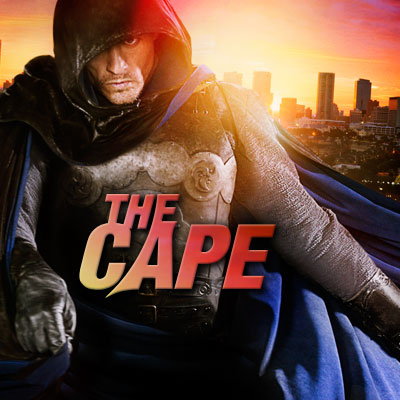
 With “The Cape,” NBC tries to regain favor with the audience initially drawn to “Heroes,” by offering another comics inspired super-hero action series. But like “Heroes” towards the end of its run, “The Cape” plays it safe, sacrificing good storytelling for empty genre-based gimmicks.
“The Cape” is a one-hour drama series starring David Lyons (“ER”) as Vince Faraday, an honest cop on a corrupt police force, who finds himself framed for a series of murders and presumed dead. He is forced into hiding, leaving behind his wife Dana (Jennifer Ferrin, “Life on Mars”) and son, Trip (Ryan Wynott, “Flash Forward”). Fueled by a desire to reunite with his family and to battle the criminal forces that have overtaken Palm City, Vince Faraday becomes “The Cape” – his son’s favorite comic book superhero – and takes the law into his own hands.
Rounding out the cast are James Frain (“The Tudors”) as billionaire Peter Fleming, The Cape’s nemesis who moonlights as the twisted killer Chess; Keith David (“Death at a Funeral”) as Max Milani, the ringleader of a circus gang of bank robbers who mentors Vince Faraday and trains him to be The Cape; Summer Glau (“Terminator: The Sarah Connor Chronicles”) as Orwell, an investigative blogger who wages war on crime and corruption in Palm City; Dorian Missick (“Six Degrees”) as Marty Voyt, a former police detective and friend to Faraday; Martin Klebba (“Pirates of the Caribbean”) as Rollo, member and unassuming muscle of the circus gang of bank robbers; and Vinnie Jones (“Lock, Stock and Two Smoking Barrels”) as Scales, resident thug and cohort of The Cape’s nemesis Chess.
With this cast and storyline, there is great potential that “The Cape” could become a huge hit series. The talented cast could easily handle meatier dialog and the show’s theme opens itself to complex storytelling. But rather than directly tackling the obvious cultural references to Orwell’s 1984, teh rise of globalims in the US, and the growing power of military industrial complex warned about by numerous US presidents, “The Cape” chickens out and makes its villain a literal monster with reptilian eyes, one-dimensional and sociopathic. This is a disappointing cop-out, especially since the protagonist is written with such realism, a mere human that has mastered illusionist parlor tricks, much like Batman.