
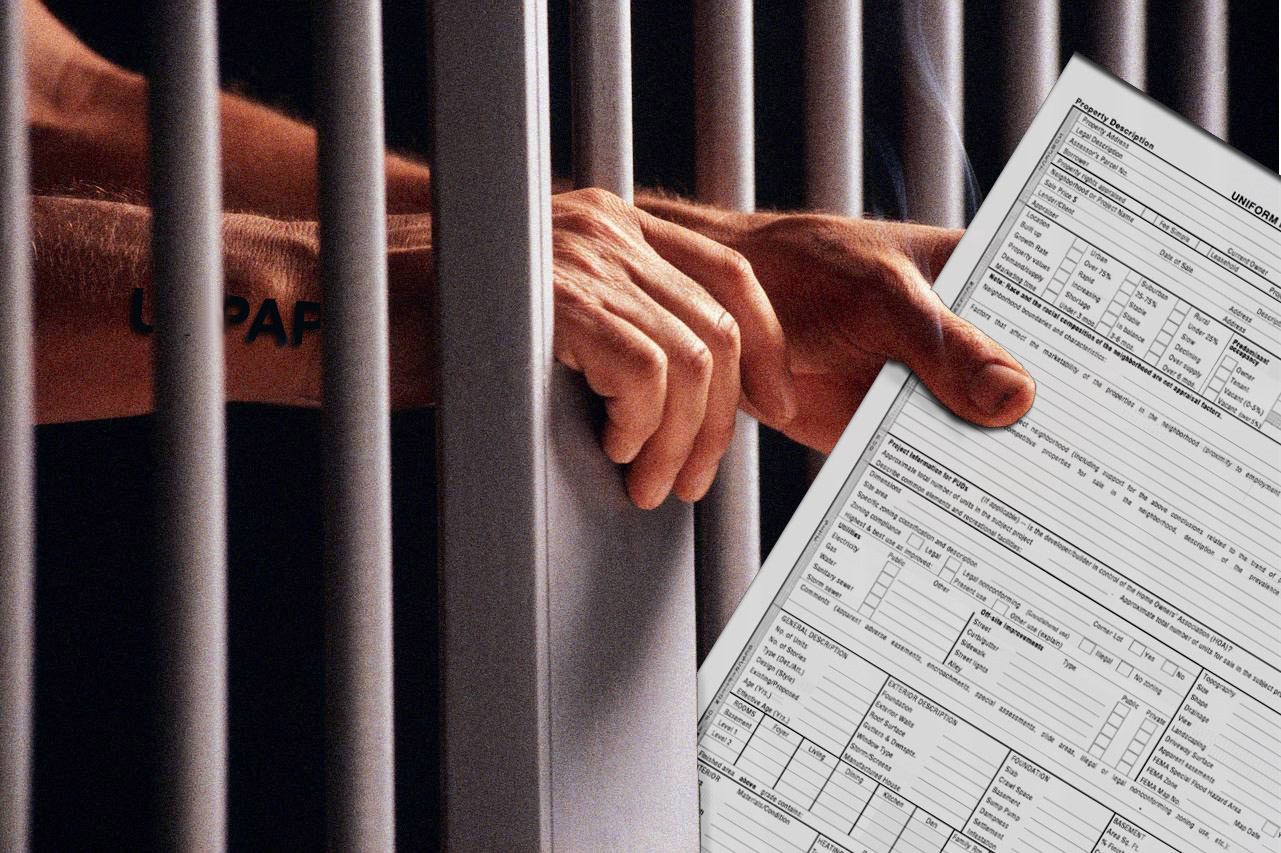
 While most Americans were watching events unfold in the Middle East, an quietly published over the weekend in a conservative mainstream newspaper claimed that the Federal Housing Finance Agency (FHFA) has plans to aggressively collect funds from “Strategic Defaulters,” namely by forcibly arresting and jailing them in a debtor’s prison. In reality, not only does the FHFA define Strategic Defaulters differently, but the FHFA is not targeting them for a debtor’s prison. Rather the FHFA is offering solutions such as short-sales, short-sales with loan forgiveness, and deed-in-lieu of foreclosure or “cash-for-keys” to strategic defaulters and jail time for mortgage fraud.
In a tone certain to gain Libertarian attention in light of the growing scandal regarding the Social Security Administration’s (SSI) purchase of 174 thousand rounds of hollow point bullets, the syndicated Chicago Tribune article, “Mortgage cops taking tough stance,” begins: “Strategic defaulters, beware. The feds are coming for you. And they are not happy. The OIG [Office of Investigator General for the FHFA] may not have the same fearsome “G-man” reputation as its better-known counterparts at the Federal Bureau of Investigation, but it is every bit as much a law enforcement agency, with the same powers to search, seize and arrest. Special OIG agents are even authorized to carry firearms. The OIG’s mission is to seek administrative sanctions, civil recoveries and criminal prosecutions against anyone who abuses the FHFA’s programs. And it is pursuing its calling with passion, if not vengeance… .”
Penned by Lew Sichelman, Senior Housing Correspondent for SourceMedia, and a syndicated columnist on real estate and housing, the article continues: “Investigators are searching not only for lenders who have sold materially deficient loans to Fannie and Freddie, but also individuals, including those who reneged on their promises to repay their mortgages. So if you are a “strategic defaulter” who decided it was better to walk away from your obligation than to keep paying for a house that was worth substantially less than you owed, it’s time to start looking over your shoulder.”
“No one knows for certain how many borrowers fit the rather amorphous strategic defaulter mold. But credit repository Experian estimates that 20 percent of all foreclosures are the result of walkaways, people who could afford to make their payments but who decided not to.”
“These are not just borrowers who made a personal, strategic financial decision not to pay. In some cases, they remained in their houses for months or even years, living free on the government’s dime — and yours and mine — before moving on. In other instances, they profited handsomely by renting their properties to unsuspecting tenants, collecting rent for many months but never paying lenders. ..”
The reality of what the FHFA plans for defaulters falls far short of armed arrests and prison. The FHFA defines Strategic Defaulters as those who decide to not pay their mortgages when they have the financial means to do so, for any reason. More important, the FHFA has made it clear that it is targeting persons who have committed fraud, which happens to be mostly institutional investors, bankers, brokers and their employees. In the FHFA’s Review of Options Available for Underwater Borrowers and Principal Forgiveness, the agency expressly states that it has come up with solutions to deal with Strategic Defaulters.
For those those who lack the desire to stay in their homes, whether because they are so far underwater, or they never had substantive equity in their homes, or because the home no longer meets their needs, or whatever other reason might apply, several FHFA programs offer a graceful exit, perhaps with financial assistance that avoids the cost and stress of foreclosure.
“For borrowers in this group, the Enterprises offer several options to ease their transitions from their current homes, each of which avoids foreclosure and its long-term consequences for the borrowers, the neighborhood, and investors. Short sales allow eligible borrowers to sell their houses in arm’s-length transactions at today’s market prices, using the proceeds of the sale to satisfy the mortgage obligations.”
“In certain circumstances, if the borrower has sufficient assets, some portion of those would also be expected to be used to satisfy a portion of the debt. If that is not the case, the short sale will be all that is required. Such transactions are effectively a form of principal forgiveness—the remaining portion of the mortgage debt is forgiven so the borrower can put that in the past, but he or she does not get to keep the house as well.”
“The Enterprises also offer deed-in-lieu of foreclosure (sometimes referred to as cash-for-keys) a program where the borrower surrenders title to the house and may be compensated for relocation expenses and associated costs for working with the lender to exit the home. This approach ensures the protection of the property, provides the borrower with financial assistance in relocating and getting reestablished, and avoids foreclosure, which could take a long time and negatively affect neighborhoods.”
“A recent change to the short sale program has shortened the waiting period for approval and other
enhancements will be announced soon.”
“These are meaningful options for relieving borrowers of a portion of their mortgage obligations if they
lack the ability or willingness to make mortgage payments on their properties. In an otherwise tough
situation, these options respect the interests of borrowers, neighbors, and lenders alike.”
The Chicago Tribune is a moderate conservative major daily newspaper based in Chicago, Illinois and the flagship publication of the Tribune Company. Formerly self-styled as the “World’s Greatest Newspaper” (for which WGN radio and television are named), it remains the most read daily newspaper of the Chicago metropolitan area and the Great Lakes region and is currently the eighth largest newspaper in the United States.
The Tribune has been widely skeptical of increasing the minimum wage and entitlement spending. Although the Tribune criticized the Bush administration’s record on civil liberties, the environment, and many aspects of its foreign policy, it continued to support his presidency while taking Democrats, such as Illinois Governor Rod Blagojevich and Cook County Board President Todd Stroger, to task and calling for their removal from office.
In 2004, the Tribune endorsed President George W. Bush for re-election, a decision consistent with its longstanding support for the Republican Party, although the paper endorsed Barack Obama for President in 2008.
Its parent company, The Tribune Company, owns Los Angeles Times, Hartford Courant, Orlando Sentinel, South Florida Sun-Sentinel, Baltimore Sun, Daily Press and The Morning Call, among others. Through Tribune Broadcasting, the company operates 23 television stations, WGN America on national cable, and Chicago’s WGN radio. The group’s combined reach is more than 80 percent of U.S. television households. Investment interests include Food Network (31%).
Tribune Interactive, another subsidiary, manages the interactive operations of major daily newspapers such as Chicago Tribune and Los Angeles Times and their associated websites. Its national network sites owned with partners include CareerBuilder.com, Cars.com, Apartments.com and Topix.net. With more than 50 websites overall, Tribune Interactive ranks among the nation’s leading news and information networks. The sites attract more than 20 million unique visitors per month. Tribune Media Services provides syndicated content to print and electronic media.
With such a wide reach, millions of consumers of conservative media are likely to have gotten the wrong impression. In fact, several lesser known conservative media outlets such as “Stock Market Watch,” “Cutting Through The Matrix” with Alan Watt and scores of consumer foreclosure advise websites and blogs have already disseminated the writer’s misinformation. But even a cursory review of the FHFA’s OIG website indicates whom the agency is actually aggressively targeting for collection and jail.
In the last year or so, the FHFA has obtained guilty pleas, indictments or prison sentences for more than 20 individuals involved in mortgage fraud cases. In each instance, the persons were tied to brokerages, banks, title companies or multi-unit/commerical real estate deals. None of them were individual homeowners. Just recently, the agency obtained an indictment against Mitchell Cohen and Erin Davis, the owner and a sales manager, respectively, of Buy-A-Home, a real estate brokerage business.
Cohen and Davis are charged with participating in a $7.5 million mortgage fraud scheme – they lied to and exploited borrowers to induce them to buy homes beyond their means, they lied to banks about the borrowers’ financial condition, and they lied to HUD so that the loans would be FHA-insured. While Mr. Cohen and Ms. Davis enriched themselves, everyone else lost out as the homeowners went into foreclosure, the Banks were stuck with bad loans, and HUD had to pay out insurance, as is detailed in the Indictment.
“It is a microcosm of the kind of conduct that brought the housing industry to the
brink of collapse,” said Manhattan U.S. Attorney Preet Bharara in an official statement.
In another instance, an entire bank was brought down by the FHFA. In 2011, the former chief executive officer (CEO) of Taylor, Bean & Whitaker (TBW) was sentenced to 40 months in prison for his role in a more than $2.9
billion fraud scheme that contributed to the failure of TBW. At one time, TBW was one of the largest privately held mortgage lending companies in the United States.
In sum, institutional corruption brought down the mortgage industry and the country’s economy. It continues to bleed taxpayers like you and me to this very day as big banks continue to get bailouts while holding onto fraud victims’ vacant foreclosed properties.