
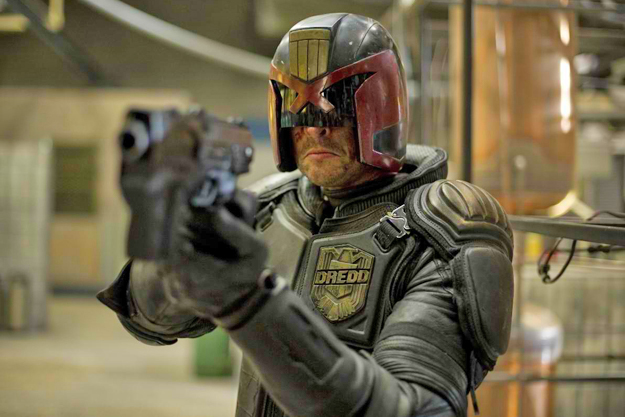
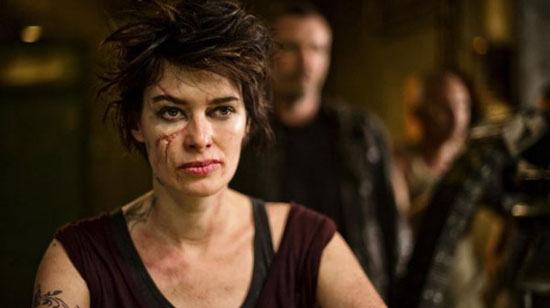
 “Dredd,” the latest science fiction movie adapted from a comic book, offers an engaging look at what humanity in an age of austerity and limited government may resemble. Directed by Pete Travis and written by Alex Garland, “Dredd,” a British-South African co-production, stars Karl Urban as Judge Dredd, a law enforcer given the power of judge, jury and executioner in the vast metropolis called Mega-City One, a walled-in city which houses about 8 million people within a series of massive 200-story towers that double as nuclear blast shelters. Accompanied by Judge Anderson (Olivia Thirlby), a rookie with psychic abilities, Judge Dredd embarks on a routine homicide investigation that brings him face-to-face with the powerful Ma-Ma (Lena Headey), an ex-prostitute turned drug lord, who controls one such tower, Peach Trees.
Peach Trees is everything anyone could imagine about the worst government housing anywhere in the world. Cabrini Greens comes to mind. Drugs, gangs, violence, public apathy and powerless resident. Now add the luxuries of modern city living, namely an on-site grocery, medical clinic, food court, etc. “Dredd” envisions the best and worst of modern society coalescing to create a fresh hell of a prison for humanity. In comes Judge Dredd, ever ready to pull the trigger when disorder erupts.
 “Dredd,” definitely not a reboot of “Judge Dredd” starring Sylvester Stalone, gets high marks for creating a relatively convincing world for sci-fi cinema. It’s not too hard to imagine an environmental collapse forcing hundreds of thousands to huddle together in towers resembling prisons, particularly when much of public housing already resembles it. It is also easy to imagine cops eagerly taking on the role of judge, jury and executioner in the future. Many would argue that American cops have already taken on that role in minority communities throughout the U.S. “Dredd” ventures into science-fiction territory when it introduces Anderson, the psychic.
Apparently, the undisclosed environmental disaster has created “mutants,” and Judge Anderson is one of the best. She can fully control her abilities and wants to use them to protect and serve. This works great as a plot device, but it begs the question whether Judge Dredd would be a sympathetic character if Anderson wasn’t there to tell him when he’s about to sentence an innocent victim to death. Producer/writer Alex Garland tackles this issue by trying to closely follow the comic book character’s nature of evolving slowly over a lengthy period of time.
“I didn’t think [judge] Dredd could have a great epiphany, but there is definitely a change in him over the course of the movie,” he said in an interview with Empire. “He makes a very clear statement at the beginning of the film which he then contradicts at the end. That’s about as far as the shift goes.” Anderson picks up the slack instead, transforming into an experienced cop, leaving her doe-eyed, jittery, gun-shy self behind.
“Dredd” also scores visually, It is beautifully shot, taking cues from “Blade Runner” and “A Clock Work Orange,” with the feel of “Warriors.” It’s got a gritty, haunting punk vibe, despite being filmed in 3D. And it retains elements of a traditional crime/gangster film, despite being set in the future. Also, a slow-motion effect is used generously throughout the film to give viewers a first-person user perspective of what it’s like to use Ma-Ma’s drug, slo-mo. When questioned about the effect, Garland said he was inspired by watching nature shows that slow down the action. 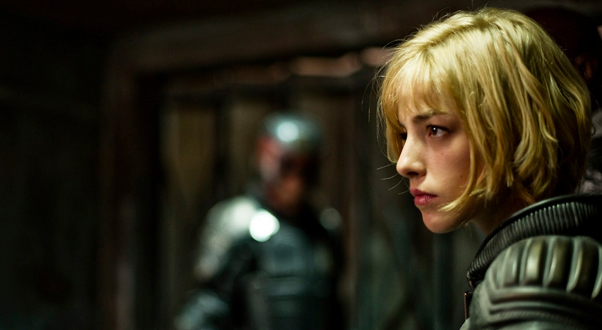
“You see a whale or a shark breach the water… then you’d stop thinking about the animal and you get transfixed by… how water droplets connect and touch against each other, Garland said in an interview withWhat Culture. “Somehow like a real [drug] trip, sort of stepping outside it but staying attached at the same time.” Garland questioned if the technique could be used with violence to make it purely an aesthetic. “Can it be so abstract that it becomes genuinely beautiful? …really aesthetically beautiful even if someone is having their cheek blown out or their head crushing into concrete?” The answer is a resounding yes.
“Dredd” is both seductive and gross, achieving a heady blend of violence and beauty. While it does nothing to advance the debate on civil liberties the value of life, it nevertheless raises these questions in a stylish manner. It’s certain to become a cult-classic.
“Dredd” is directed by Pete Travis and written by Alex Garland. It is based on the 2000 AD comic strip “Judge Dredd” and its eponymous character created by John Wagner and Carlos Ezquerra. The project was shot using 3D cameras throughout on practical sets, and on location in the South African cities of Cape Town and Johannesburg.