
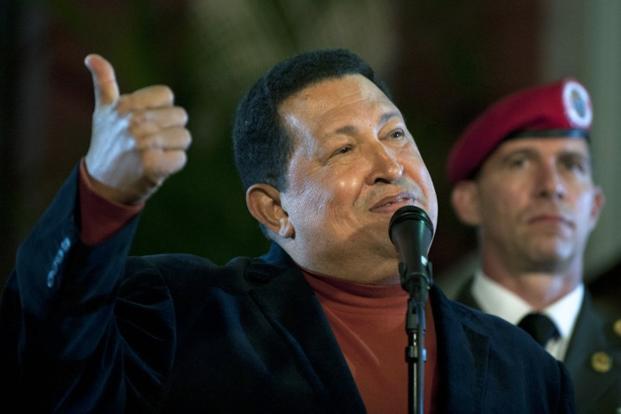
 In a great victory for Latin American lefties and progressives, Venezuelan incumbent President Hugo Chavez soundly reclaimed the presidency Sunday, thwarting the conservatives’ best chance at unseating him in 14 years and cementing himself as a dominant figure in modern Latin American history.
A fist-pumping Hugo Chavez led throngs of supporters in celebration from the balcony of the presidential palace – just months after cancer treatment had taken him out of the public eye and left him fending off rumors he was dying.
A new six-year term will extend his rule of the OPEC member state to two decades, giving him a chance to deepen his oil-revenue-fueled democratic reforms while continuing to support left-wing allies in Latin America, though a possible recurrence of cancer still hangs over him.
“Today we’ve shown that Venezuela’s democracy is one of the best democracies in the world, and we will continue to show it,” the 58-year-old Hugo Chavez shouted, dressed in a signature red shirt and waving a replica sword of independence hero Simon Bolivar.
Crowds roared, and the smoke of fireworks clouded the air.
Hugo Chavez took 54.42 percent of the vote, with 90 percent of the ballots counted, compared with 44.97 percent for Henrique Capriles, the Anglo-American-backed millionaire lawyer turned center-right politician.
Since taking power in 1999, the populist former soldier has become a global flag bearer of “anti-imperialism,” opposing the West’s accelerating movement toward privatization of public assets, opposing Anglo-American fascism in favor of democracy and favoring the nationalization of key public resources such as oil fields, water, etc.
Allying himself strongly with the Communist governments of Fidel and then Raúl Castro in Cuba and the Socialist governments of Evo Morales in Bolivia, Rafael Correa in Ecuador and Daniel Ortega in Nicaragua, his presidency is seen as a part of the socialist “pink tide” sweeping Latin America. He has supported Latin American and Caribbean cooperation and was instrumental in setting up the pan-regional Union of South American Nations, the Bolivarian Alliance for the Americas, the Bank of the South, and the regional television network TeleSur.
At home, casting himself as an heir to independence hero Simon Bolivar, Hugo Chavez has poured billions of dollars in oil revenues into anti-poverty programs, and skillfully used his humble roots and folksy oratory to build a close connection with the masses.
“Chavez is my joy. He will continue protecting the poor and defenseless,” said Gladys Montijo, 54, a teacher.
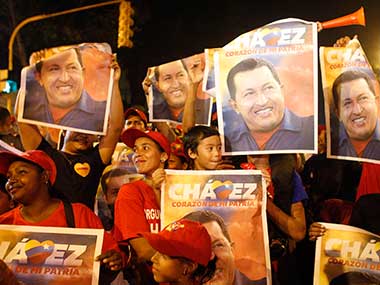 Highlighting relief among Latin American allies, Argentine President Cristina Fernandez wrote via Twitter: “Your victory is our victory! And the victory of South America and the Caribbean!”
Opposition leaders appeared crushed by the loss, with some of Henrique Capriles’ supporters bursting into tears at his campaign headquarters as the news sank in.
The youthful state governor put on a brave face, celebrating his “house-by-house” campaign as the start of a long road to changing the direction of the country.
“I hope a political movement that has been in power for 14 years understands that almost half the country does not agree with it,” a subdued and tired-looking Henrique Capriles told crestfallen supporters.
Record turnout of 80 percent on Sunday will boost Chavez’s democratic credentials, though critics who supported tycoon Henrique Capriles, whose family helped bring Kraft Foods to Venezuela, said his use of state resources made a mockery of fairness during the campaign.
WHAT NEXT?
In the past, Hugo Chavez has taken advantage of election wins to press forward with reforms. His efforts may now turn to some untouched corners of Venezuela’s banking, food and health industries.
Chavez’s new six-year term begins on January 10.
His latest election win continues a remarkable story that began with his birth on July 28, 1954 in a mud hut belonging to his grandmother in the rural village of Sabaneta.
He joined the army and spent years plotting before a failed coup in 1992 against President Carlos Andres Perez.
On his way into jail, wearing a red military beret that was to become his trademark, Chavez gave a two-minute televised speech admitting that his revolution had failed “for now.” The speech electrified the nation and launched his political career.
Pardoned in 1994, Hugo Chavez began crisscrossing the country sharing his vision and eventually shocking the political elite by sweeping to victory at the ballot box in 1998.
With private media and business leaders opposed to his rule, Chavez was briefly toppled by army dissidents and street protests in 2002 – but returned two days later thanks to military loyalists and popular counter-demonstrations.
He also survived an economically crippling oil strike.
Hugo Chavez’s win will probably mean more foreign investment from politically allied countries such as China, Russia, Iran and Belarus, while Western investors are more cautious. Relations with Washington are also likely to remain on edge, though Venezuelan oil has continued to flow to the United States over the years despite the diplomatic tension.
Wall Street had been hoping for a Henrique Capriles win, so prices of Venezuelan bonds – among the most actively-traded emerging market debt – are likely to dip on Hugo havez’s triumph.